What is the Perfume Project?

This blog is a constantly evolving forum for thoughts on perfume, perfume-making, plants (especially orchids and flora of the Pacific Northwest) and life in general. It started out chronicling the adventures of Olympic Orchids Artisan Perfumes, established in July 2010, and has expanded in other directions. A big part of the blog is thinking about the ongoing process of learning and experimentation that leads to new perfumes, the exploration of perfumery materials, and the theory and practice of perfume making. I no longer post reviews of the perfumes that I sample, unless specifically requested to do so. To counter my inherent grumpy tendencies, I try to write about something I appreciate at least once a week. Once in a while I get up on my soapbox and write about things that aren't at all related to perfumery. I am grateful to all of you, the readers, who contribute to the blog by commenting and making this a truly interactive perfume project.

Friday, December 30, 2011

CIRCLES AND CYCLES: HAPPY NEW YEAR!


I’ve lived in a lot of exotic places, and one of them was Texas. Part of Texas culture is Willie Nelson, and one of the songs I remember hearing when I lived in Texas was an oldie of his from 1974, “Phases and stages, circles and cycles, scenes that we’ve all seen before…”. For some reason this song that I hadn’t thought of in years popped into my head when I was thinking about New Years. Last year I did a New Years post on this blog, and this year I’ve come full circle and am doing another one. Déjà vu.

This past year has been good. I’m still gainfully employed, my orchids are growing well, and the perfume business is starting to take off. 2011 was mostly spent mixing perfumes that have already been released for a while, packaging them, and sending them all over the world. I’ve made huge improvements in the production and packaging process, and am now set to produce in much greater volume than I could this time last year. In the meantime, development of new perfumes has slowed down a lot. Phases and stages.

I have two new perfumes ready for release next year. The first is the rose chypre, which after much thought I’ve decided to name Ballets Rouges. Many thanks to Queen Cupcake and Gail, whose suggestions were hybridized to come up with the final name. You both win a prize! The second is Salamanca, a leather and dry grass fragrance. However, Salamanca cannot officially be released until I’ve secured a reliable bulk supplier for a couple of the hard-to-find natural materials I used in it. I originally got them from a vendor who has gone out of business and am currently searching for another vendor. I’m optimistic that I’ll find a source and that it will be a go in early 2012. Salamanca is one of my favorites, and I’d like to share it with others. [Celina, whatever happens, there’s a bottle on hold for you!]

My perfume plans for 2012 are to get back to formulating, focusing on an affordable but polished all-natural line and an upscale series showcasing some of the wonderful natural materials that I have obtained in relatively small quantities over the past year. These will probably be limited editions, and a little more expensive than my standard line, but still affordable. I’ll also work on a couple more orchid fragrances and scents of place. I would like to upgrade my website to a custom format instead of the ready-made template that I’m currently using, but realistically, this may take a while and require some help.

On the personal level, I don’t make New Year’s resolutions because I know I’ll just break them. However, I do make plans. I was inspired by Ines to try to downsize my huge collection of clothes, shoes, and costumes, or at least store the costumes in the communal stash for my theatre group, which is fortunately located at a site other than my house. I’ve already taken the fog machine there, and the clothing and props will follow, freeing up some space for storage of perfume materials.

I’m going to try to start running regularly again, since it’s one of the things that helps keep me sane, along with music and perfume. I’m going to write some new plays. I’m going to try to post on this blog nearly every day even if you, dear readers, get fed up with my ramblings.

I’m going to try to keep juggling, as I have been all along, living at least five lives in parallel, each with its own set of demands. I can’t give up a single one of them.

As I write this, I’m wearing 10 different Arabic perfumes simultaneously to celebrate the new year a day early (I’ve found one of the newly-arrived lot that I really, really like), and have successfully made my second ever batch of amaretto-walnut fudge, consuming several small cocktails made of 2/3 Sailor Jerry’s rum and 1/3 Amaretto in the process. I don’t think it’s an official drink, but it tastes good. It needs a name - any suggestions? People in my neighborhood are already setting off fireworks for New Years, so I guess it’s time to wish you a Happy New Year, and happy perfume sniffing to all in 2012!

Thursday, December 29, 2011

THE ROAD TO NO NONSENSE PERFUMES PART 1

Sometimes a post on another blog really gets me going. This morning it was Marla’s satire on Mirabella the Cat and the accompanying discussion of what induces one to actually buy a bottle of perfume. I started responding to it in the comments section and halfway through realized that I had practically written a whole blog post.

I was particularly sensitized to the issue of nonsensical hype because I recently sampled Creed Love in White, which epitomizes ridiculous advertising. In fact, it can practically hold its own with Mirabella the Cat and her special demographic. First, the facts about the fragrance (Creed, not Mirabella): Love in White starts out as jasmine surrounded by aquatic and “manly”-spicy notes. As it evolves, the jasmine shares the stage with generic florals and harsh, synthetic woody notes, giving the whole composition the aura of a functional scent for a shampoo amped up to 80s proportions, with tremendous sillage and skin-bonding tenacity.

Now for the hype: Apparently a number of celebrities wear Love in White. Who cares which celebrity wears a perfume? Their taste is not mine. Why is it that all of the perfumes reported to be favorites of celebrities (or at least owned by celebrities) are overpoweringly filled with floral notes, especially jasmine? Are they meant to be used as repellants to keep the paparazzi at a distance? I suppose the target demographic is celebrity wannabes, who are probably as numerous at department store perfume counters as cats are in the alleys of Naso Asqueroso, Baja California, where, according to the buzz, Mirabella spends her winter vacations.

Celebrities aside, the promotion of Love in White is further degraded by all the circulating hype about Oliver Creed traveling the world for 5 years in his yacht searching for the stuff that went into this fragrance. In all fairness, this overblown version of the story seems to be an urban legend fabricated by the retailers who sell Creed, since the Creed website itself simply mentions a love of sailing and materials from five continents. Good for Mr Creed that he can afford a yacht and have the leisure time to travel on it, but I don’t understand why department stores and other perfume outlets think they can sell the product by making it sound as if he got off his yacht in thousands of exotic locales, saw exotic plants growing in the jungle or on the beach, extended his magical hand and said “Let there be essential oil, tincture, or absolute” and there was essential oil, tincture, or absolute. I would be willing to bet that an employee of the Creed company ordered all of the materials used in Love in White from a wholesaler or bulk producer the same way I order my materials. I also use materials from 5 continents, as does just about any other perfumer who uses naturals. There’s nothing special about it. The difference is that Creed can order in mass quantities, so the same materials end up being much cheaper for him than they are for me or any other indie perfumer. Personally, I don’t want to subsidize the purchase and operation of other people’s yachts through my perfume purchases.

I guess the point is that what a perfumer or their advertising staff says can be completely ridiculous to begin with, or it can start out just mildly off-putting and become distorted by the retailers and the media as it is repeated over and over again, eventually becoming thoroughly ridiculous.

Wow! I really went off on a tangent about Creed and their retailers, and didn’t get to the main point about my evolving quest to make and market top quality no-nonsense perfumes at no-nonsense prices. That will be Part 2 of what is quickly becoming a series. Stay tuned.

Wednesday, December 28, 2011

THE MAKING OF SIAM PROUN


I sometimes write about the process of making specific perfumes, but there are a good many in my current production that I have only mentioned in passing. When I learned yesterday that Siam Proun was given one of Cafleurebon’s “Best of 2011” awards, I realized that it was time to write about it.

When I was a young teenager my family lived in Provence, in a lovely Mediterranean-style villa with a terraced garden around it. The property went by the name “Siam Proun”, which in Provencal means “we are sufficient”. I’m not sure where the name came from, but it has stuck with me. Living in the south of France was one of my mother’s long-held dreams, and Siam Proun represented the realization of it. That period was probably one of the happiest times of her life.

I’ll never forget the journey south from Switzerland, where the whole family had been living, from the bleak cold of November on Lac Leman to the relative warmth and lushness of the Mediterranean. We all felt like we had arrived in heaven. I remember breathing the warm, friendly air filled with the scent of rosemary, thyme, lavender, heather, and other greenery. The garden was pretty much filled with these herbs, as well as an umbrella pine and a couple of small citrus trees, probably lemon. Next door was a small orchard of fig trees whose trunks were always covered by a hoard of hungry escargots.

This past year when my mother was very ill I wanted to do something special for her, so I made a perfume just for her, and called it Siam Proun. I used a thick, woody, oriental-type amber base to provide warmth and topped it off with the scents of Provence - orange blossoms, heather, lavender, rosemary, thyme, and a touch of some other things like rose and yuzu, just to round it out. It turns out that this particular formula is one that needs to age for a while before everything is blended properly, and I didn’t realize how good it was until I smelled it much later, after it had been sitting for a while. In particular, the lavender combines with the patchouli in the base to produce a bright, sharp note that Michelyn on Cafleurebon described as “luminous”. I’ll go with that term.

I think Siam Proun has probably turned out to be an oriental for people who generally prefer green perfumes, and maybe a green perfume for those who usually prefer orientals. Tarleisio wrote a beautiful review of it on her blog before it was even officially released. I can easily see how Siam Proun could evoke “the path to Mount Meru where the world began, a frieze of beautiful temple dancers, dancing for the glory of Vishnu just above the milky ocean”. For me, so many years ago, a villa in the Alpes-Maritimes was the center of the universe, a magical, mythical mountain covered with cork oaks, flowers, and herbs just above the sparkling indigo blue and turquoise sea, a place that can only be revisited in dreams or perfume-induced fantasies. I like to think that my mother was able to revisit Siam Proun, Mount Meru, and everywhere else that her dreams took her in the last months of her life, and that the perfume helped facilitate these visits.

Finally, I’d like to thank Michelyn and Cafleurebon for honoring Siam Proun with their recognition. I can't think of a better way to end 2011.

Tuesday, December 27, 2011

OTHER PEOPLE’S COOKING


I’m a good cook. I have no false modesty, so I admit it. I can eat a dish at a restaurant, analyze it, and re-create it at home. I love to throw dinner parties and pull out all the stops on the food and wine. I’m not so thrilled by the day-to-day feeding routine, and always welcome a chance to eat someone else’s cooking whether it’s at a fancy restaurant, a taco truck, or at the home of friends or relatives. For me, there’s a strange psychological effect at work that makes other people’s cooking always taste delicious even if I know on an intellectual level that I could have done it better myself.

Perfume is the same way. I seldom wear my own perfumes, probably because of the truth of the adage, “familiarity breeds contempt”. After pipetting dozens of sample vials of a fragrance I get tired of smelling it. I know exactly what’s in it and the exact concentration of each ingredient, I worry about whether I need to reorder materials, and whether one or more of those components is going to suddenly become unavailable. There’s no mystery or mystique to the fragrance, no room for fantasy. That only happens while I’m formulating a new perfume or the rare times when I catch a whiff of one of my own perfumes that has inadvertently caught a ride on my clothes and for a second I don’t recognize it as mine.

Given that I get so much pleasure from smelling other people’s perfumes, I was inspired by Diana’s (Feminine Things) recent series on perfumes that inspired lasting love versus those that were brief flings. It made me think about which perfumes I seek out for more than a one-test stand. There aren’t many of them, given my promiscuous sniffing behavior, but there are a few that have made it to decant or small bottle status. This is not a “best of” list, even though it’s that time of year, but simply some perfumes that perform specific functions extremely well. Here are the first five that seem to have inspired a lasting relationship, part one of a two-part series.

Madini Ambre. This perfume oil is my ultimate go-to comfort scent, the one I wear when I want to feel lulled to sleep, or when I just want to kick back and relax. It’s not a conventional amber scent. It’s profoundly woody, like being rocked in an aromatic hardwood cradle with a little honeyed labdanum dabbed on it. It’s unique. I’ve used it for years and still love it. It’s the only perfume for which I have a backup bottle.

Montale White Aoud. This is a relatively new love. I became infatuated with it when I wore it last summer on a trip to northern BC in Canada, and have come to love it. Ever since the road trip with White Aoud, I’ve worn it from time to time when I want a special perfume treat. If Madini Ambre is comfy pajamas, Montale White Aoud is a sequined evening dress. It contains all of the traditional Arabian perfume components, wood, oud, roses and saffron. There’s a lot of vanilla to warm it up, and some spices to spice it up. The rose note is one of the very best that I’ve smelled anywhere. This combination is as near to perfect as it gets, assertive but at the same time comfortable and soft. It’s my special-occasion go-to perfume.

Keiko Mecheri Cuir Cordoba. For the past couple of years this been one of my workhorse perfumes, one that I can reach for in the morning without thinking when I have to go out in public for the day. It’s beautiful but not aggressively so. It starts out with violet, leather, and incense, and dries down to a smooth, subtly sexy combo of violet, leather and sandalwood that lasts and lasts. Applied with restraint, it stays close enough so that I can enjoy it myself without imposing it on others.

Sonoma Scent Studio Ambre Noir. This is another new love, a meditative, intellectual, spiritual perfume that is like standing in a dense forest of huge evergreen trees. It starts out with a full blast of labdanum, sandalwood, fir sap, cedar wood, and a little incense. As it dries down, I can smell oud and vetiver, as well as more cedar, and the labdanum resin that is always there. It’s as if Laurie Erickson had captured the bare-bones spirit of an Arabian perfume, removed all the lavish decorations, and distilled it down to its dry, ethereal, woody soul. I wear this when I’m alone, in a contemplative mood.


The Different Company Sel de Vetiver. This is another workhorse perfume that I wear especially when I’m working in the theatre, if I feel like wearing any perfume at all. A great many of my acting colleagues claim to be “allergic” to perfume (although others slather themselves with essential oils or continually spray themselves with strong scents), so out of consideration for the perfume-haters I try to go easy on the fragrance. Sel de Vetiver starts out like grapefruit with salt sprinkled on top of it but soon turns into a veil of gray, bitter vetiver accented by a hint of dry, peppery spice and something floral, focused mainly on iris. Once the bitterness goes away, it’s a gorgeous, perfect combination of subtle notes that provide a good bit of sillage but would be hard to localize or find offensive. A beautiful workhorse indeed.

[Montale, Keiko Mecheri, Sonoma Scent Studio and TDC photos from commercial websites]

Sunday, December 25, 2011

CHRISTMAS ORCHIDS


It’s just a coincidence, but imagine waking up on Christmas morning to find that three of your biggest orchids have burst into bloom overnight, and one of your smallest. Well, that’s what happened in my greenhouse. The red cattleya of perfume fame has been pumping its buds full of juice, dripping sugar, and gearing up to go for a couple of weeks now. Today three of its eight buds are suddenly open, and the others will be open by the end of the day. Last year it had seven flowers, this year it has eight. The plant and flower stalk are almost three feet (1 m) tall.

The other big cattleya that opened its buds last night is Cattleya labiata, a species that I raised from a tiny seedling. This is its first bloom, with just three flowers, but they’re full-sized with lavender petals and a frilly, striped, “landing-strip” lip. I included my hand on the flower stalk to give an idea of the size of these standard cattleya flowers. Neither of the cattleyas has started to produce fragrance yet, but I’m looking forward to enjoying the real red cattleya again and finding out what labiata smells like.

Chysis bractescens opened its buds, too, revealing its fleshy, creamy white flowers with a yellow lip. These flowers are already starting to produce their gourmand bourbon vanilla- with narcissus scent.

The fourth orchid that opened its buds overnight is Sophronitis cernua, a miniature mounted plant that I am displaying in the house hanging on the pot of the Cattleya labiata. It has two clusters of three flowers each, the brilliant red-orange flowers contrasting perfectly with the green leaves. Unfortunately, these flowers have no fragrance.


The solstice is a prime time for some orchids to bloom. Phalaenopsis are mostly winter bloomers. Right now one of my favorite hybrid phals is in bloom, Brother Yew x Carmela’s Spots. I generally don’t like hybrid phals, but this one is a cream color with so many tiny maroon stipples all over that it looks solid maroon color from a distance. Its lip is a deep maroon. The reason why it’s my favorite hybrid is because it’s strongly fragrant, with a rich, citrusy, floral-perfumey scent that it dispenses in large quantities during the day.

Also blooming are Phalaenopsis amabilis,with solid white flowers, Phragmipedium bessae, another orchid with brilliant orange-red flowers, Dendrobium laevifolium, a mini with red-purple flowers, and Dendrobium hercoglossum, a midsize plant with a multitude of lavender-pink flowers. This last one doesn’t really count, since it blooms all the time, but the number of flowers does peak around the solstice.

All in all, it’s a good day for orchids.

Saturday, December 24, 2011

ARABIAN PERFUMES: MAJID MUZAFFAR ITERJI PART 1


To continue my exploration of Arabian perfumes, here are five from Majid Muzaffar Iterji. From the information on their website, this company appears to be a well-established Saudi Arabian perfume manufacturer. They specialize in traditional, mid-level perfumes that, in my experience, are quite variable in quality. Some of their offerings can be purchased fairly reasonably online in the US from Amber and Musk.

I think I’ve mentioned this before, but I find it interesting that most of the online vendors of Arabian perfumes downplay or completely omit the names of the manufacturers. I find this practice extremely annoying, especially since many of the common, traditional names for perfumes are used over and over again by just about every perfume manufacturer.

Majid Muzaffar Iterji Oud Mubakhar Malaki (spray)
An oud fragrance pure and simple, this alcohol-based perfume is woody, resinous, aromatic, very natural smelling. I love oud, and that’s what this is, even though it’s probably just a good synthetic reconstruction. It’s simple enough to really let the single note shine, the only embellishment being a tiny bit of spice, probably cinnamon. The fact that this is an alcohol spray rather than an oil cuts down on the intensity, making for a nice light woody sillage that lasts for about 6-8 hours.

Majid Muzaffar Iterj Ehtefal
This alcohol-based perfume starts out with strong citrus and a touch of aldehydes, as well as some sharp white flowers. It seems like more of a European designer-type perfume than an Arabian one, but it’s stronger and a little more pleasant and natural-smelling than many of its Western counterparts. I’m not a big fan of citrus-florals, but this one is enjoyable to wear. As it dries down it becomes warmer and smoother, remaining floral, but in a way that manages to appeal to me. The sample I got was generous, so I’ll probably use this in my rotation when (or if) I want a fresh, citrusy floral.


Majid Muzaffar Iterji Ward Al Manara
As would be expected from the name, this perfume oil is an extremely strong rose, with powerful citronella notes and a strange woody undertone that I find detracts from the rose. To me it smells extremely synthetic. It stays completely linear for the entire time it’s present, which is only about 3-4 hours, starting out too strong even when carefully dabbed, but fading quickly. This perfume oil was a big disappointment.

Majid Muzaffar Iterji Al Berwaz
This perfume oil is strong and predominantly woody, with oud, cedar, and other similar notes, mostly the “other” notes. In the opening there are undertones of lavender, rose, and fruit. I would characterize this as smelling more masculine than feminine, probably because it’s sharp and not at all sweet despite the fruit and floral notes. The scent is linear, lasting 6-8 hours. I like it, but it would not be one of my top choices from this perfumer.

Majid Muzaffar Iterji Mukhallat Al Manara
This perfume oil contains the typical mix of citrusy rose, saffron and oud. It’s sweet, it’s strong, it’s good, it’s long-lasting, it’s linear, and it’s very traditional smelling. This is an excellent scent that is among my favorites from this perfumer.

Friday, December 23, 2011

WEEKLY RAVE: PERFUME-LOVING (?) CAT


We are lucky enough to have a cat that consents to grace our household with his presence and let us be his servants. He’s of unknown age, but at least 14 years old, having come to us of his own accord as an adult. He’s of unknown breed, although the closest guess would be a long-haired Russian blue. In the winter his coat is so long and thick that it hangs down almost to his feet and includes a lion-like mane around his neck. In summer, he loses most of it and becomes a sleek short-hair. At all times his hair is so thick and downy at the base that his skin cannot be seen and he’s completely protected from rain, which slides right off the top layer of his fur. Watching this cat’s coat adapt to the seasons is fascinating as is watching him climb trees, gallop through the tall weeds and grass, and hunt, catch, and eat small animals. He’s an indoor-outdoor cat, completely independent through use of his cat door, and perfectly able to take care of himself if we go away for a week or so.

Indoors, he’s unusually well-behaved, never scratching anything, never jumping on the kitchen counters, or doing any of the other unpleasant things cats often do. He walks carefully among plants and perfume bottles, and has never damaged either. Mostly he politely ignores perfume smells, but did become intensely excited the first time I opened a bottle of synthetic civet, running around the house at breakneck speed as if he were searching for the animal producing the smell. He reacted this way to civet a few times, but seems to have gradually gotten used to it, especially since over the years my perfume-making area has taken on a characteristic base scent of its own that includes a civet note. I think it’s due to small amounts of scent being absorbed by the plastic drawer storage units that I use for raw materials.

If I’m working on perfume, the cat will often come to the door and meow at me. I’m not sure if he likes or dislikes the scents I’m setting free to float around in the air, or if he just thinks I’m invading “his” space, since he sometimes likes to hang out in that room. I think he’s gotten used to smelling something different every day and, if it gets to be too much for him, he can go outside and sniff the fresh air and the multitude of cat-friendly scents that an acre of mostly forested land offers his little gray nose.

His only vices, if you can call them vices, are getting on the keyboard whenever anyone is playing and attempting to play along. Once he’s been shooed off the keys, he’ll sit on the back part of the keyboard and enjoy the music. He also likes to get on our laptop keyboards if we’re typing, and he’s been known to add to documents and even send e-mails to people. This post was inspired by the photo at the top, in which I found him sleeping on my laptop keyboard (granted, it was probably a warm place), reaching his paw out for the mouse.

Do you have pets? What do they think of your perfumes?

Thursday, December 22, 2011

WINTER SOLSTICE 2011


When you live as far north as I do, the winter solstice becomes an important event. When I got up today, it was still nearly dark, with just a faint pink glow in the sky. There was frost on the ground. It definitely looked like the dead of winter. As I write this, it’s after 10 AM and the sun is still near the horizon, shining almost horizontally through the line of cypress trees at the back of the yard. The sky is bright blue, and I can see the snow-covered Olympics from my window as I write. There will be a few hours of sunshine, then darkness again starting around 4PM.

The orchids in my greenhouse are mostly in lockdown mode, hunkered down trying to get through December with minimal light and warmth. What never ceases to amaze me, though, is that a couple of weeks after the days start to lengthen, the orchids always go into a frenzy of new growth. I’m looking forward to seeing that!

Some orchids choose the winter solstice as a blooming time. I have blooming laelias, dendrobiums, phragmipediums, and phalaenopsis in the house right now, none with a particularly noteworthy fragrance, or rather, none that I haven’t already written about. The big, highly fragrant, winter-blooming cattleyas are in full bud right now, ready to pop open around Christmas day.

When I walk outside, the cyclamens are blooming away, even under their coating of frost. I love cyclamens! They’re my favorite solstice plant. The arbutus bushes, also known as “strawberry trees” are blooming with their little sprays of white, bell-shaped flowers, and the hazelnut trees are covered with catkins. In the Pacific Northwest, the lines between fall, winter, and spring are a little blurred, so that some trees are blooming before others have completely lost their leaves. The biggest cue we have about the changing of the seasons is day length.

This morning I was working on a new batch of Gujarat, which is one of my best-sellers, and my hands still smell like Vanuatu sandalwood. Sandalwood is an excellent scent for the solstice, thick and woody, rich, and slightly sweet, perfect in the cold air outside, and just the thing to enhance the warm, cozy atmosphere of being inside.

My favorite things about the solstice are the feeling of coziness and hibernation during the dark hours, the down time from work and the opportunity to get together with friends and family, and the feeling that the worst days of winter will soon be over and the natural world will come alive again. The symbolism of death and rebirth. Best wishes to all who read this for whatever solstice-related holidays you may celebrate.

[Bridge with sun photo from Wikimedia]

Tuesday, December 20, 2011

MORE ON ARTEMISIA: ABSINTHE AND ARMOISE


In my quest to explore Artemisia species, I ordered some Artemisia absinthium oil. The vendor also had Cymbopogon validus, also known as African bluegrass, so I’m testing the two of them in parallel. I’ll be writing about the African bluegrass in another post on Cymbopogon species used in perfumery and cooking. However, I also realized that I have essential oil of yet another Artemisia species, Artemisia vulgaris, also known as armoise, wormwood, or mugwort, so will compare it with the newly-acquired absinthe.

Armoise has a dry, slightly bitter, slightly sweet scent that reminds me of sage, tarragon, and aromatic greenness. I used it in Kingston Ferry to help produce the salty, leathery-leaved, herbal green scent of the gardens and beach areas near the ferry dock. It would be a wonderful addition to any perfume that has a strong herbal note.

Absinthe essential oil is stronger and more bitter than armoise, dry, woody, and sharp, but with the same tinge of saltiness. It even has a hint of oiliness in the beginning before the bitter, woody character fully develops. It has nothing to do with the typical anise and fennel flavoring used in the drink absinthe, but does presumably contribute a bitter character similar to that found along with other flavorings in vermouth. In perfumery, I can see it contributing to deciduous wood accords like oak.

The common naming of Artemisia species is confusing, to say the least. Several of them are called “wormwood”, several are called “mugwort”, and the flavor that’s typically associated with absinthe is not Artemisia at all. I would never buy an essential oil called “wormwood”, “mugwort”, “absinthe”, or “Artemesia” without knowing the species.

[Artemesia plant photos from Wikimedia]

Monday, December 19, 2011

PROFILE ON CAFLEUREBON: CHECK IT OUT!


I am excited and grateful to Michelin Camen of Cafleurebon for featuring my profile as part of her "Profiles in American Perfumery" series. If you're curious about some of my very early background, there are tidbits of it in the article. Maybe best of all, it includes a drawing for a full bottle of the Olympic Orchids perfume of your choice.

Thank you Michelyn and Cafleurebon!

Sunday, December 18, 2011

ON LEARNING PERFUMERY


A while back a perfume-maker colleague asked me the following question: “What is your opinion on studying perfume making? Do you think that enrolling in a perfumers’ course or school has an advantage over self study?” When I was writing a biographical sketch (as a perfumer) on Friday, I was once again reminded of this issue, so I thought it might be interesting to revisit it.

In a nutshell, my answer is that I think the type of training one chooses depends on his or her goals and intended approach to perfumery. For someone who wants to work in the mainstream, corporate, commercial fragrance industry, formal training is probably necessary, not just as a tangible qualification, but also for quickly acquiring the specific set of knowledge and skills related to conventional fragrance formulation for various purposes, including large-scale production of functional scents for non-perfume products.

For someone like myself, who works far outside the conventional corporate box and is mostly interested in what could be characterized as “art perfumery”, I think self-instruction is certainly a viable way to go, although my advice now, knowing what I do, would be, "Don't try this at home". There’s a huge amount of basic information available on the internet, in books, and through networking groups like the Yahoo perfumemaking group. In the same way that one can learn music “by ear” through listening, watching videos, and reading about music theory, one can learn perfumery “by nose” through sampling individual materials and existing perfumes and reading about perfume-making theory. When it comes to hands-on work, the advantage of self-teaching is that there’s no predetermined structure constraining one’s personal vision and scope for experimentation. As in any other art, one needs to learn some basic theory and “rules” in order to bend or break them intelligently, but perfumery is so subjective that the “rules” are not as rigid as in music, for example.

I think it might be fun to take a formal in-person course, but I’m afraid that at this stage of the game I might not be a very compliant student, having little or no patience for elementary exercises for their own sake, especially if I’m paying for them. I’ve looked at ads for a lot of online “courses”, but concluded that some of them seem excessively dogmatic in implementing a specific “method”, or their main goal is to sell “starter kits”, and/or they didn’t seem to offer anything I couldn’t get (or haven't already gotten) on my own.

In any case, one of the most important parts of the learning process in perfumery is becoming intimately familiar with all of the materials with which we work. That takes a lot of time and money and patience - there’s no way around it. The advantage of formal training is that one has a plan laid out for doing this. The advantage of being self-taught is that the process of learning the tools of the trade happens in an evolutionary way that’s optimal for the individual rather than in a quick, lock-step sequence.

For me, the evolution started with years of exposure to, and experimentation with, natural materials, simply because they were readily available. If I have a special fondness for natural materials, it’s probably because that’s what I have the most experience with, but as I’ve learned about man-made aroma materials I’ve developed a deep appreciation for them, too.

The more I smell and work with any material, the more it becomes like a living creature with its own personality. If I had to pick a material that I love to smell straight up, it would be a 20+-year old frankincense that’s one of my original essential oils. It’s so incredibly beautiful that I don’t want to use it, so I’m hoarding it just to smell from time to time when I want inspiration.

I decided to work with man-made materials as soon as I started seriously trying to create perfumes. Naturals are wonderful to work with, but there are things that they just can’t do. To create the scents that I have in my mind, I usually need something to supplement the natural materials. Adding synthetics opens up a huge range of additional possibilities, sort of like going from unamplified acoustic guitar and voice to the possibility of a full band or orchestra complete with electronic sounds. I have to say that there was quite a steep learning curve in figuring out how to use synthetics, and I’m nowhere near through learning yet. I love all of my materials, both natural and synthetic, because each has a purpose even if I haven’t discovered it yet, so I spend time tinkering with my "organ" full of materials whenever I can. I suspect that another advantage of self-teaching is that it never stops.

[The photo at the top shows part of my work area. Other parts of the room contain a sink, glassware storage, and a shelf with analytical balance and racks to hold vials for pipetting samples. Storage areas are located elsewhere.]

Saturday, December 17, 2011

WEEKLY RAVE: LITTLE PERFUMED THINGS


During my recent cleaning frenzy I went through the basket where I keep all of the mini soaps, shower gels, shampoos, conditioners, and lotions that I’ve compulsively brought back from hotel bathrooms whenever and wherever I’ve traveled over the years. My original intent was to have a selection of products for house guests to use, but the guests have used very few of them or brought their own, so that I was left with a basket in which some of the bottle contents had dried up or otherwise spoiled. The thought was good, but the inventory has to turn over regularly to keep it usable.

I threw away the bad items, and decided to use up the good ones. I started with a complete set of shampoo, conditioner, and body lotion that I got on a business trip when I was put up at a fancy hotel on the East Coast. They’re all Bulgari Eau Parfumée au Thé Blanc, and I’m loving them. The hair products mostly smell like ambroxan, and scent the whole bathroom with it as it diffuses in the shower steam. The little hint of scent that stays on my hair after rinsing is mostly ambroxan and musk.

Of course a mini-bottle is only good for one or two hair washings, so they’re long gone. However, the tiny bottle of lotion just keeps dispensing its contents like a bottomless well. Its scent is more complex than that in the shampoo and conditioner, with some herbal and floral notes as well as the ambroxan, and lots of musk. It’s overwhelmingly strong, so I use just a tiny drop mixed with another lotion that’s mildly scented with natural oils. The result is still strong enough to make my hands radiate a definite ambroxan-musk scent all day and perfume my sleeves. That mini-bottle is probably going to last for two months or more! If I used it in the intended amounts, I can only imagine that it would quickly fumigate a room, and I have visions of groups of stodgy, serious-faced business travelers sitting around in a conference room, all stinking to high heaven of ambroxan and musk from their morning shower.

I don’t think I’d ever wear the perfume, but I’m certainly enjoying a lotion that I’d never have tried unless I’d brought it home with me as a souvenir of a long-ago trip. I love little sample bottles of everything!

Thursday, December 15, 2011

THE GIFT OF PERFUME: YEA OR NAY?


This week on the forums there have been numerous questions asked along the lines of “Which perfume should I buy for my niece/ mother/ grandmother/ husband/ co-worker/ teenage son/ neighbor/ child’s teacher…etc?” Personally, I don’t think the question is “which perfume to buy”, it’s whether or not to buy perfume for someone else in the first place.

Maybe I’m way off base, to say nothing of not doing myself any favors as a perfumer by writing this, but I don’t think perfume is a good default gift. It seems more like the proverbial fruitcake that no one wants, but that nevertheless keeps getting given and given, and finally re-gifted this time of year. I actually like to eat fruitcake, so wouldn’t mind if somebody gave me one. If there’s a fruitcake circulating the neighborhood like the notorious garbage barge that circumnavigated the globe trying to find a country to take its load, I’m the ideal dumping ground. The more nuts and candied fruits and rum, the better. But perfume? I’ve had some bad experiences with blind perfume gifts. Would you really want to receive a 200 ml bottle of Red Door? A big gift set of some cheap box store synthetic lavender fragrance? I’m sure you can name your own unwanted perfume gifts.

Perfume preference is a highly personal matter, as is the preference for whether to wear perfume at all. In the US, an astoundingly large number of people are perfume-phobic, professing to be “allergic” to perfume. They won’t go near it unless it’s in a utilitarian disguise like laundry detergent, air freshener, cleaning products, or shampoo. Why would you give them a bottle of perfume?

For those of us who would fall in the perfumista category, we have our own ideas about what we would like to receive as a gift, and unless the person giving the gift knows that we would like full bottles of Sonoma Scent Studio Incense Pure, Montale Taj and White Aoud, Neil Morris Gandhara, or Swiss Arabian Kashkha, they’re probably going to give us something we don’t like or already have.

It seems like it would at least be worthwhile to find out if the recipient of perfume likes and wears it, and if so, what some of the items on their wish list are. Otherwise, you might as well give them a fruitcake.

What do you think about perfume as a gift? If you’re reading this, you probably love perfume, so the question is whether you’d appreciate a perfume gift from someone who knew nothing of your collection and tastes. Another related question would be, what are the best and worst blindly chosen perfume gifts you’ve ever received?

[Gift wrapping and Fruitcake photos adapted from Wikimedia; Perfume gifts painting detail by Pieter Brueghel the Elder, 1564]

Wednesday, December 14, 2011

RANDOM PERFUME REVIEW: RICH HIPPIE GROOVY


Some time ago I got a bunch of what I thought were perfume oil samples when TPC had them on sale for 75% off. Even with the deep discount they were still the same price as a normal upscale sample, i.e. a little more than I like to spend on samples. They seem to be alcohol-based rather than oil, and are probably no more than EdT strength. Most of them are not listed on Fragrantica, where I usually post my reviews, so I’m going to be reviewing them here, a few at a time. As always, I would like to emphasize that I write this review strictly as a consumer, not as an expert of any kind, and it simply reflects my own idiosyncratic, often curmudgeonly, personal tastes and opinions.

My introduction to the Rich Hippie offerings was Groovy. I’ll spend a bit more time on it than the ones that will follow, given that it epitomizes all that I dislike about this line. The first thing I smell in Groovy is strong rosemary, lavender, citrus, and evergreen tree needles. The other thing that I must be smelling is the juniper berry that’s reported to be in it. Whatever this concoction contains, it’s weak, it’s all top notes, and it’s fleeting in the extreme. From opening to the final drydown, it’s present for no more than 20-30 minutes and then, poof! - it’s gone. Groovy! A perfume that does a magic disappearing act! Man, like how cool is that?

I am totally mystified by how Rich Hippie can sell perfumes that last such a short time for so much money. From what I smell in Groovy, there are no expensive absolutes or other materials that could justify the outrageous price. The oils that I smell are some of the cheapest available, even if they’re the best of the “organic wild-crafted” crop as they claim. The “peace, love and harmony” that their blurb mentions were all free last time I checked, although admittedly in short supply.

Aside from the outlandish prices, the most disturbing thing about Rich Hippie is the rhetoric on their website. They state that “prior to World War II, all fine perfume was 100% natural and chemical-free” Huh? Ever heard of Chanel No. 5? Any of the other early 20th century classic perfumes? And what are natural materials if not chemical? Oh right - they exist only in the mystical corridors of the imagination and don’t really have an odor. But even then there are chemicals being released from synapses, so I don’t understand the whole “chemical” argument.

Ranting about “chemicals” in all contexts is fairly common, but the Rich Hippie website goes on to expound upon how “synthetic” perfumes are made from “petroleum” and how harmful they are to one’s health and how they “promote tumor growth”. Using scare tactics to sell perfume is not what I would call a “best practice”. After reading this I am appalled that I shelled out even a small amount of money for products from a company that spouts so much misinformation.

Don’t get me wrong. I have nothing against all-natural perfumes. In fact, I love good natural perfumes, and natural materials. I have nothing against emotional leading tactics in advertising. All perfume is advertised to appeal to the emotions rather than the intellect, and many advertising blurbs are pure flights of fantasy. However they do not masquerade as historical or scientific facts. A company that sells perfume at exorbitant prices should at least get their facts straight and use positive inducements to buy their product rather than unfounded scare tactics.

If you want some all-natural scents like Groovy, you might as well go to your neighborhood health food store, buy some essential oils for a few dollars and dilute them in a carrier oil. You’ll get just as good a scent with better longevity, and can use the money you save to buy a month’s groceries, a nice leather jacket, or a collection of old Simon & Garfunkel albums. Feelin’ groovy!

[Hippie-theme graphics adapted from Wikimedia]

Tuesday, December 13, 2011

BREAKING NEWS: WATER MAY PREVENT DEHYDRATION! (BUT IT HASN’T BEEN PROVEN)


According to this article that Gail turned me onto, there’s a new EU ruling that bans companies that sell bottled water from stating that water helps prevent dehydration. Sheesh. No wonder the EU is in deep trouble.

Let’s start with the least ridiculous part of the story first. Why do companies need to state the obvious? Are people not buying enough water packaged in eco-hostile little plastic throwaway bottles? After all, the bottled water manufacturers don’t manufacture water, they just manufacture bottles (or buy them cheaply) so that people can drink a few sips from them, throw them away, and buy still more plastic bottles. The more bottles that are sold and thrown away, the more that sector of the economy grows. How about spending all of that money on providing clean, drinkable water to municipal water supplies everywhere so that people don't have to buy bottled drinking water?

Do people really not know that drinking water in its pure form or mixed with various flavorings will keep them from getting dehydrated? I can see the lawsuit now: Some idiot didn’t know that he needed water, because no one ever told him, so he never drank any liquids and died of dehydration. His family then sued the bottled water company for not publicizing the fact that drinking water from time to time is a good thing.

After participating for a short time on a US running forum where 90% of the discussion was on losing weight and “staying hydrated”, I had to conclude that people in today’s society don’t have sense enough to stop eating when they’re full, or to drink when they’re thirsty. It’s sad.

Anyway, on to the second half of the story, which is the EU’s decision to ban water sellers from stating that, “regular consumption of significant amounts of water can reduce the risk of development of dehydration”. Yes, that is the exact wording as given in the article. The company doesn’t even come out and actually say that water prevents dehydration, let alone “cures” it, they beat around the bush like the cosmetics companies that state that their product “if used regularly may help reduce the appearance of wrinkles”, or my favorite from many years ago, a company that stated in a print ad that its product had “totally nugatory effects”.

Now for the best part of all: After a three (yes, 3!)-year investigation, the EU determined that the statement could not be scientifically proven, and banned water bottlers from making any claims about water reducing the risk of developing dehydration, under threat of two years imprisonment. I wonder how much the investigation cost the Brussels administration and the EU as a community? Did someone actually search the scientific literature for studies “proving” the obvious? Do we need formal studies to tell us that eating food reduces the risk of starvation, or that breathing air reduces the risk of suffocation? Or that using common sense reduces the risk of engaging in stupid behavior?

If this incident had been on a comedy show, I would have laughed and dismissed it as an over-the-top joke. As it was, I had to search for other related news stories to confirm it and make sure that the date line was not April Fools Day. Apparently it’s true, although I still have nagging doubts, so I can only shake my head in wonderment about the absurdity of the whole incident and conclude that when one form of stupidity encounters another, they mate and produce an exponential increase in stupidity all around. Even if the story’s a hoax, the tendency of stupidity to reproduce exponentially still provides a good sociological model.

[Bottled water before and after pictures from Wikimedia]

Monday, December 12, 2011

MY WEEKEND “CURE DE SOMMEIL”


This past weekend I didn’t post anything because I came down with a horrible cold, accompanied by full-blown flu symptoms. On Saturday I slept over 14 hours, and yesterday I slept about 20 hours. Today I’m almost recovered, ready to go in to work and give a final exam. When I’m sick, this is what my body tells me to do - just sleep till I’m better, and it seems to work wonders.

When I was a kid living in France, I remember hearing someone say that she was going to go do a cure de sommeil - a sleep cure. I don’t know exactly what it entailed, but I imagined that she just went to relaxing place far away from all distractions and slept to her heart’s content. An informal cure de sommeil is how I deal with migraines, flu, and anything else that hits me.

People in this society don’t get enough sleep. In the US, anyway, there’s a puritan idea that “early to rise” is somehow virtuous, and that work done before 10 AM is more valuable than the same work done later in the day. Many people have to be at work by 5 or 6 AM, and even school children have to be at school by 7. This time of year, they’re out in the cold and the dark waiting for the school bus. It seems cruel, especially for teenagers, who need to sleep in.

During the fall academic quarter, I was getting up at 7:00 every morning, which is not a good thing given that I typically don’t go to sleep until 1:00-2:00 AM. I need my 8 hours. Getting sick was probably a reaction to chronic sleep deprivation, allowing me to finally catch up a bit. I figure that if I’m able to sleep 20 hours at a stretch, my body must need it. Everybody needs a cure de sommeil from time to time. I highly recommend it! And don't wait to get sick.

[Sleeping Beauty painting by Henry Mynell Rheam, 1899]

Saturday, December 10, 2011

ARTEMISIA: THE OTHER SAGE


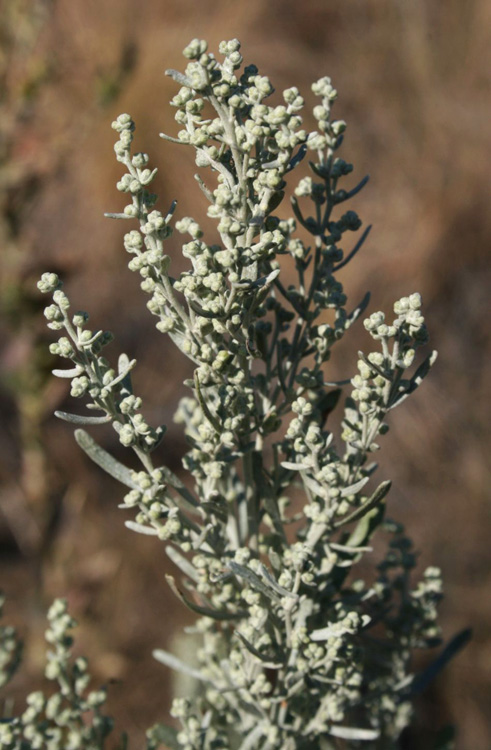
When I wrote about sage the other day, I mentioned sagebrush, which is not sage at all, but Artemisia tridentata. Artemisia is another widespread genus with hundreds of species, some of which are useful in perfume making.

Artemisia tridentata, commonly known as North American sagebrush, is one of the shrubby, drought-resistant bushes that grows all over the western part of the US in desert-like areas, including Eastern Washington. The plant is woody and tough, with leathery, silvery-gray leaves and yellow flowers. The essential oil, made from the leaves and stems, not the flowers, has a dry, pungent fragrance that’s a little like garden sage, but much more “wild”- smelling. If you could call a plant “gamey”, sagebrush would fit that description. I use this oil in my Arizona fragrance as part of the desert vegetation note.

Artemisia absinthium, or wormwood, is another shrubby plant with silvery-green leaves, and was the ingredient for which absinthe was named before it was regulated and reformulated using anise flavoring. Its traditional medicinal use is to eliminate parasitic worms from the gut. Historically, it was also used to flavor vermouth and some other wines, and may still be used that way in small amounts. So far I have not found this essential oil for sale by any of my usual sources, but I did locate some to try, and it should be on its way.

Artemisia dracunculus is garden-variety tarragon, used in cooking. It’s smaller than the other Artemesia varieties, the leaves are greener, and it has a characteristic fragrance that falls somewhere in the space between anise, basil, and sweet clover. I used tarragon in Kingston Ferry as part of the aromatic herbal component.

[All plant photos from Wikimedia]