What is the Perfume Project?

This blog is a constantly evolving forum for thoughts on perfume, perfume-making, plants (especially orchids and flora of the Pacific Northwest) and life in general. It started out chronicling the adventures of Olympic Orchids Perfumes, established in July 2010, and has expanded in other directions. A big part of the blog is thinking about the ongoing process of learning and experimentation that leads to new perfumes, the exploration of perfumery materials, the theory and practice of perfume making, the challenges of marketing perfumes and other fragrance products, and random observations on philosophy and society. Spam comments will be marked as such and deleted; any comments that go beyond the boundaries of civil discourse will also be deleted. I am grateful to all of you, the readers, who contribute to the blog by commenting and making this a truly interactive perfume project.

Wednesday, July 15, 2015

ARCHITECTURAL BLUNDERS: STORES WITH NO DOORS


Having grown up in places where houses, apartment buildings, shops, and all other buildings are entered straight from the street, I never cease to be mystified by the peculiar design of entrances in suburban (and pseudo-urban) areas of the US. The perpetration and perpetuation of dysfunctional design really struck me the other day when I drove down a local thoroughfare where a wasteland of derelict structures had been torn down and the entire area rebuilt to look like an urban street lined with shops, complete with sidewalks. Forget about the fact that everything is one story, with no living spaces above the shops. It still looks like a huge improvement over the used car lots and abandoned K-Mart that were there before.

At least I thought it was an improvement until I realized that there were no visible entrances to any of the shops! Further investigation revealed that, indeed, the structures that looked like they might be doors were not. There were no entrances at all from the street side, just fake facades that looked as if there should be entrances. Unless the whole thing is a completely fake façade like the ones that were painted or built in Northern Ireland to hide economically depressed areas before the 2013 G8 summit, all of the entrances to these buildings must be acessed from a strip-mall type parking lot on the other side. Why build a sidewalk and storefronts if they’re not meant to be functional?

The question of why there are no street-side doors is especially relevant because there appears to be a good bit of foot traffic in the area. There’s a bus stop on the corner, and in the few minutes I stood on the other side of the street taking pictures, a bus stopped to load and unload passengers, and a number of pedestrians walked up and down the street. Granted, maybe dentists, stockbroker’s offices, and mobile phone retailers are not prime candidates for drop-in customers and impulse buys, but most of the strip is occupied by restaurants, hairdressers, snack shops, and such. I would be willing to bet that if there were an attractive, inviting entrance from the street, these shops’ business would double.

Architects and planners need to move past the unfortunate 20th-century notion that everything has to be designed for automobile traffic, a notion that has probably resulted in more urban and suburban blight and destruction of the natural environment than anything else in history. It has certainly made much of the US an ugly, depressing and dysfunctional place to live. If as much thought, energy, and resources went into making communities truly human-friendly as goes into creating the appearance of doing so, this would be a better place to live.

[All photos are mine]

Thursday, July 9, 2015

HAPPINESS IS HAVING A NEW WEEDEATER!


When you live on a quasi-farm as we do, noxious plant control takes on a certain importance and urgency. If you’ve ever read books by Tom Robbins, you may remember his seemingly over-the-top descriptions of blackberries in Seattle. The ugly truth is that everything he writes about blackberries is true. Within a year they can take over an entire one-acre lot and bury any buildings that are in their path. The blackberries are usually surrounded by various sorts of grass and weeds that block access to them, like lines of foot soldiers protecting tanks and heavy artillery. Because of Michael’s injured foot, this summer I am the sole defender of our property against these invaders.

My usual strategy is to use a weedeater to cut down the grass and small blackberry starts to get at the mature ones. The adult blackberries often have trunks up to 5 cm in diameter and tangled canes many meters long. The most insidious thing of all is that in late summer the tips of the canes send out roots and form new plants wherever they touch the ground. This means that a single blackberry plant can spread in giant steps over an enormous area.

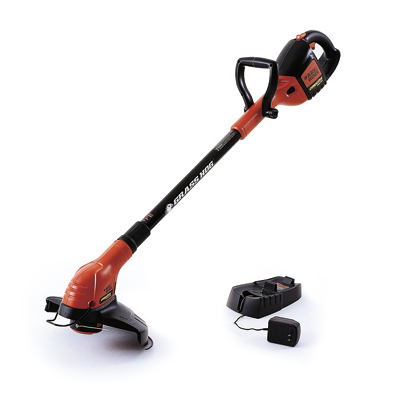
For the big blackberries, I have to use heavy-duty pruning clippers to cut them down and chop them up. Some people go to the gym to exercise, but I spend up to an hour a day cutting down invasive weeds and blackberries. I have a problem with weedeaters, which are mostly made for tall men. I can’t use one that’s longer than I am tall, so have been limited to a clunky battery-powered one with adjustable length called a “Grass Hog”, shown in the photo below right. This week the poor little Grass Hog died of exhaustion, overtaxed by the rigors of cutting heavy weeds and brush, so we had to go in search of a replacement.

Apparently they don’t make Grass Hogs any more, nor do any of these devices go by the name of weedeater. I suppose it’s not politically correct to insult a tool by calling it a “hog”, or to imply that weed is being eaten, even though it’s perfectly legal to do so in Seattle. Maybe it’s no longer politically correct to call unwanted forms of vegetation “weeds”. I don’t know. In any case we found a battery-powered “string trimmer”, as they're now called, with adjustable length and a 40-volt rechargeable battery that lasts 2-3 times as long as two of the old Grass Hog's batteries used to do (the new one is in the lead photo for this post). The new battery charges up so quickly that I could go out and weed-eat three times a day if I had nothing else to do. It seems like a strange thing to be happy about, but there’s something perversely satisfying about killing non-native invasive plants, and especially blackberries.

I have to bring perfume into the picture somehow, so will observe that the scent of whacked-down vegetation is very different throughout the year. In the late winter and early spring, the scent is moist and green, with the occasional pungent smell of a shredded tansy mugwort, the weirdly aromatic scent of Geranium robertianum, or the characteristic odor of fresh, juicy blackberry stems and leaves. We haven’t had a drop of rain since May, and the sky is filled with smog from wildfires, so this time of year the smell of cut vegetation is mostly dry and dusty, with the unpleasant odor of concentrated blackberry leaves and stems, accompanied by the occasional scent of a ripe blackberry. If we ever get any rain, I look forward to the scent of water hitting dry ground and pavement, but that may be a few months off given the typical weather patterns. 

[Weedeater photos are from retail websites; blackberry photos are mine]

Friday, July 3, 2015

GROWING FRANKINCENSE TREES


As a plant and perfume enthusiast, what could be more perfect than growing a selection of plants traditionally used in perfumery? I’m not talking about roses and orange blossoms, I’m talking about more exotic things like frankincense and myrrh trees.

Recently I’ve gotten into growing cacti and succulents, thanks to a cactus that bloomed and produced 91 babies. When I saw baby frankincense trees for sale, I knew I had to have one. My first desert tree acquisition was a Boswellia carteri, the species most commonly used to make resin and oil [photo on right]. When it arrived, it looked like a bare-root dead stick with no leaves. I planted it, watered it, and within a few weeks some tiny, frilly leaves had begun to sprout. It’s now doing quite well in a hot spot high in the grow space. These trees go dormant when conditions are non-optimal, so I expect it will go lose its leaves again in winter.

One thing led to another, and I’m now the proud caretaker of a tiny Boswellia dioscoridis [photo on left] and a Boswellia neglecta, as well as a larger Commiphora wightii. [photo at bottom right, along with a Bursera fagaroides]. The Commiphora arrived just like the B carteri, as a dead-looking stick, and took forever to leaf out. However, it's now growing quite well. I’m on the lookout for an affordable Commiphora myrrha, the main species used to make resin and oil, but will have to be patient until one comes along. 

These all belong to the general class of pachycaul trees, which are fat-trunked trees that store up water for hard times – perfect for my conditions.

Pachycaul trees all seem to do OK in my hands, unlike the patchouli plant that I bought a couple of months ago, which turned out to be a disaster. The patchouli was nice and green when it arrived, but I quickly discovered that it goes through water even faster than a hydroponic basil plant. If not watered every day, it wilted. It also seems to want high humidity, which I simply can’t provide in the summer. I can’t deal with plants like that, so within a couple of weeks it had burned to a crisp despite my best efforts. No more patchouli for me. I will consider the poor patchouli plant a sacrifice to the gods of gardening to facilitate the growing of plants that can go for long periods of time without water like the little Boswellia trees.

I doubt that I’ll ever harvest resin from my frankincense or myrrh trees, but I just like having them around to remind me where the materials I use come from. 

[All photos are mine]

Saturday, June 27, 2015

WINNER OF THE MARIA AMALIA DRAW

The winner of the Maria Amalia draw is LILLIAN HOLLOWAY.

Please contact us with your full shipping address. The e-mail is olympicorchids at gmail dot com. US shipping only.

Friday, June 26, 2015

TALKING IN PHOTOS


There’s a saying, often true, that a picture is worth a thousand words. However, there are times when a word is worth a thousand blurry pictures.

I’ve always been puzzled by the fact that perfume people so often post a picture of a perfume bottle instead of naming the perfume. This happens on the forums when people post comments about a perfume. They seem unable to write out the name and, instead, link to a photo of the bottle. Sometimes it’s clear what it is and other times it’s not.

On the Facebook groups and other similar venues, people often post pictures of bottles. Sometimes it’s possible to identify them, but other times the photos are too dark, too low resolution, or just too poor quality overall. Maybe posting an unidentifiable photo makes people feel superior to the ignorant masses who cannot immediately identify every perfume in existence by the general shape of the bottle. It can’t be laziness because it would be far easier just to type out the name of the perfume than to search for and download a little gif file or use their phone to take a poorly lighted photo in their bedroom or bathroom.

The fact is that many perfume bottles look similar, so it’s not possible to tell what they are based on their general outline. No one wants to have to zoom in on a photo to try to see what it is, especially since the name will probably still be unreadable due to the low resolution of the image. If anyone out there can provide insight into why people use photos instead of perfume names, I’d be curious to hear your explanation. 

If anyone can identify the bad photo in this post, you will receive a valuable prize.

[This photo is mine, processed to degrade the quality] 

Sunday, June 21, 2015

SUMMER SOLSTICE AND AN ORCHID THAT SMELLS LIKE CARNATIONS


Today is the longest day of the year (or shortest if you’re in the southern hemisphere), so it represents a turning point in the seasons. It’s a time for reflection on the spring that just passed and the summer to come. For me, it’s a time to send out the summer Scents of the Seasons to subscribers. Happy solstice to all!

This spring was a whirlwind for me, passing by in what seemed like no time. Summer should be calmer, with July being a month in which I can focus on formulating a couple of new fragrances, upgrading the websites, doing some promotion and some writing.

A botanical treat this month has been Bulbophyllum patens, an orchid that belongs to a genus noted for its stinky flowers that smell like feces and/or rotten meat. This one, on the other hand smells a lot like carnations! It has that same clove scent along with some light fruity-floral notes. The flowers have a mobile lip that jiggles in the breeze, enticing insects to light on it. Apparently in the wild, it is pollinated by fruit flies, males of which are attracted by methyl eugenol, the clove note, raspberry ketone, and zingerone, a ginger-like scent. All of these are perfectly good perfume materials. I discovered that if I press down on the lip as an insect would, the lip catapults upward, presumably throwing the insect against the pollinia. 

I did a little reading and, according to this account, what happens is that flies light on the lip to feed on the chemical attractants that it secretes, and as they progress inward, the lip reaches a see-saw fulcrum point, flipping the fly into the column cavity, with the lip acting as a closed door behind it. Trying to escape, the insect backs up, catching the sticky pollinia on its back. When it visits another flower, the process is repeated, with the pollen being deposited in the appropriate slot. All I can say is that these flowers are amazing, both for their co-evolution with fruit flies, and for the beautiful scent that fills the air around them.

[Summer sunrise at Stonehenge photo from Wikimedia; Bulbophyllum patens photos are mine.]