What is the Perfume Project?

This blog is a constantly evolving forum for thoughts on perfume, perfume-making, plants (especially orchids and flora of the Pacific Northwest) and life in general. It started out chronicling the adventures of Olympic Orchids Perfumes, established in July 2010, and has expanded in other directions. A big part of the blog is thinking about the ongoing process of learning and experimentation that leads to new perfumes, the exploration of perfumery materials, the theory and practice of perfume making, the challenges of marketing perfumes and other fragrance products, and random observations on philosophy and society. Spam comments will be marked as such and deleted; any comments that go beyond the boundaries of civil discourse will also be deleted. I am grateful to all of you, the readers, who contribute to the blog by commenting and making this a truly interactive perfume project.

Showing posts with label Fragrant orchids. Show all posts

Tuesday, July 29, 2014

FRAGRANT DENDROBIUMS


This summer I’ve had a couple of fragrant surprises from the Dendrobium side of the greenhouse. The first was a little Dendrobium palpebrae that had been quietly and unobtrusively growing in a corner, but suddenly burst out with big pendant sprays of white flowers with bright yellow centers. Best of all, they were strongly fragrant, smelling distinctly “perfumey” in a designer-fragrance sort of way, but in a good way. They had a sharp scent that was a bit like a combination of geranium and patchouli, amber (in the mass-market sense) and lily-of-the-valley. Nice, but not something I would want to reproduce since it’s too similar to many other perfumes.

The second surprise awaited me when I got back from San Francisco. A little Dendrobium moniliforme ‘Kinkaku’ had produced an exuberant bouquet of big white flowers with lime-green throats. Finally, a Dendrobium moniliforme whose flower buds escaped the hungry mouths of the slugs that like to sneak in and eat the Dendrobium and Masdevallia buds!

A couple of years ago I made a perfume based on the fragrance of another Dendrobium moniliforme variety, ‘Osafume’. Those flowers have a delicate anise-like scent, but the ‘Kinkaku’ flowers are totally different. In fact, I smelled them in the greenhouse before I saw them. They have a strong fragrance like rose-scented soap enriched with spices, especially nutmeg. When I smell these flowers, I could swear it’s some sort of fancy lotion. It’s not something I want to mimic, but it’s fun to smell flowers that appear to reproduce typical manmade scents that we think of as smelling "synthetic". It’s also interesting to observe how different cultivars of the same species can have dramatically different fragrances. 

[Photos of Dendrobium palpebrae and the flower of Dendrobium moniliforme 'Kinkaku' are mine] 

Saturday, June 21, 2014

RECREATING ORCHID SCENTS


The other day a customer contacted me asking me why no one has accurately recreated the scents of some of her favorite hybrids. It should be simple, right? Can’t one just do a chemical analysis of the molecules that are in the orchid fragrance, then put them together? In theory it should be as simple as following a recipe. Unfortunately, it’s not that simple. 

Of course it is possible to do a gas chromatography (GC) analysis of any orchid’s fragrance headspace, and this has been done for some species, sometimes multiple times in multiple contexts. Some of these data are available online. However, once that's done, there are several issues that make it difficult or impossible to reconstruct the scent of your favorite orchid plant with complete accuracy:

1. Orchid scents are not uniform across individual plants, even for cloned hybrids. My Cattleya Bob Betts may smell very different from yours. Even the flowers of a single plant can smell dramatically different depending on culture conditions, the weather on any particular day, and how mature the flower is. To further complicate things, the flowers may smell completely different in the morning than they do at night. Which version to use? If I use my morning, young flower, grown in cool sunny conditions version, you may not recognize it.

2. Orchid flowers are continually emitting a complete mix of base notes (large molecules), middle notes (mid-size molecules) and top notes (small, volatile molecules). In a perfume, the top notes evaporate after a while, leaving the heavier molecules, so the scent evolves over the course of wearing it, losing progressively larger molecules until you’re left with only the heaviest ones. To achieve a "live-flower" effect with a perfume, you would have to continually spray yourself, in which case you would quickly overdose with the middle and base notes.

3. Many of the chemical components of orchid fragrances are not available commercially to perfumers. 

4. It is not practical (and maybe not even possible) to distill enough orchid flowers to produce an oil or absolute that could be used in perfumery. In any case, the products of distillation or extraction of any flower do not really smell like the fresh flowers.

These same issues apply to any sort of flower fragrance, but are easier to tackle in flowers like orange blossom or rose that can be cultivated commercially on a large scale and distilled by the ton to produce a natural oil or absolute with many of the characteristics of the original. Because of their huge diversity (over 800 genera and more than 20 thousand species) and the complexity of their scents, orchids are some of the most difficult flowers to try to recreate in perfume form. 

[All photos are mine: Sedirea japonica (top), Phalaenopsis bellina (middle), Stanhopea wardii (bottom)]

Wednesday, July 17, 2013

PARTY’S AFTERMATH, RED LILIES, AND OTHER RANDOM THINGS


The Blackbird party on Saturday night was a huge success. Nicole, the owner, and Liz, her assistant, did an amazing job of decorating the place with all kinds of vegetation, flowering orchids, and bell-jars full of blackberries and hydrangea flowers. The perfumes were beautifully displayed, there was wine sponsored by Wine World, champagne, vodka, lots of snacks, and best of all a wonderful mix of people from the Seattle perfume community. It was a real pleasure to see those I’ve met before and to meet new people. I am dismayed that I forgot to bring my camera, and was too busy and distracted during the event to even think of using my phone to take some pictures. If anyone reading this has any photos, I would love to see them! Surely someone took a photo or two? Why is it that taking photos at social gatherings is always somewhere at the bottom of my priority list? I seem to be hopelessly bad at documenting events of this sort.

Last weekend was strange in a number of ways. Saturday night was the launch party at Blackbird, and Sunday was the memorial service for my mother-in-law who died about two weeks ago. There’s no need to go into details about that, but there is one spin-off that’s of interest from a perfume point of view. After the reception, several family members divided up a huge bouquet of roses and lilies that were still in bud. The poor flowers were sprinkled with little dabs of silver glitter. I suppose some florist felt a need to gild the lily. Because Michael’s sister doesn’t like the smell of lilies, she took the roses and I took all of the lily buds. In the car on the way home, I smelled something phenolic, very much like guaiacol. It was the lilies. I don’t know whether these lilies had been bred to eliminate the powerful floral smell that most lilies have, or whether they were just an odd variety, but the fragrance continues to be bizarre and phenolic even now that they’re opened up fully. They have a little bit of the normal floral smell, but it’s minimal.

If you haven’t ever smelled guaiacol (why on earth would you?) it has a slightly smoky phenolic-medicinal smell that’s quite disgusting in large amounts. Now I’m beginning to wonder if all lilies have this phenolic note, but that it’s usually masked by other things?  Could the phenolic note be the reason why some people dislike the smell of lilies so much? Have the breeders who seek to eliminate flowers’ fragrances inadvertently eliminated everything except the note that people dislike?

Another random observation is that the “voodoo lily” bulbs that were given to me last fall are finally sprouting. I have no idea what will develop, but it’s always a surprise to find plants that I had completely forgotten about showing up in the garden.

Two of my orchids are blooming for the first time, putting on a surprise flower display. The first is Bulbophyllum lasiochilum (photo at beginning of post), which has wonderful red-spotted flowers accented with dark red, and nearly black petals and sepals. It smells a lot like cloves, at least at this stage of flower development. The second surprise was a little Cadetia taylori (photo at left), with tiny white flowers only a few millimeters in diameter. The lip is yellow and fuzzy like velvet, the petals are thin and curved, looking exactly like an insect’s antennae, and the fragrance is a strong anise-like scent. 

Saturday, June 8, 2013

WELCOME SUMMER!


The ebb and flow of academic life creates its own seasonal pattern, much like the seasonal patterns in nature, primitive cultures, and farming communities. Last week was the final week of classes and the official beginning of professors’ three months of summer unemployment. The financially lucky ones take on a temporary job funded by a federal agency through their grant(s) and spend a luxurious three months concentrating on their research. Others dig into their meager savings account to pay the mortgage and buy groceries, hoping that the summer doesn’t bring any major house or car repairs or other expensive disasters. The pre-tenure people and the post-tenure masochists continue working their butts off as usual, without pay, while the hedonists take the summer “off” to regroup and write.

In any case, having a 9-month salary and benefits is infinitely preferable to being one of the increasing crowd of poorly paid and horribly exploited part-time faculty who are in the precarious position of being hired by the semester or quarter to teach undergraduates, often at multiple institutions.

When I started writing this post, I intended it to be a joyous ode to the beginning of summer, but maybe I was influenced by the fact that the weather today is cold and cloudy rather then the beautiful warm sunshine we’ve had for the past week or so. In any case, Thursday evening after teaching my last class of the year and attending the last faculty meeting, I collapsed and slept for a full 12 hours. When I woke up, I suddenly felt restored to a near-normal state, and ready to launch into my summer activities, sort of a mini death-and-rebirth experience.

The onset of summer has brought all kinds of little gardening treats. The tuberoses that I planted last year have come up again, stronger than before, so there’s hope for them. We ate the first artichokes from the garden yesterday. They were tender and delicious, better than anything I’ve had from the store.  Cherries and strawberries are getting ripe. The outdoor garden orchids are all in full bloom, as are the peonies and roses. Yesterday I bought a star jasmine plant in full bloom, and will be adding it to the garden as soon as I decide where to put it.

In the greenhouse, there are distinct olfactory contrasts. Angraecum didieri is blooming with its powerful, gorgeous, tropical white flower nocturnal fragrance, and Rhynchostylis coelestis is emitting its lilac-like daytime fragrance for a 24-hour perfume fest. The Rhynchostylis is one of those orchids that has bluish-colored flowers, something fairly unusual among orchids.

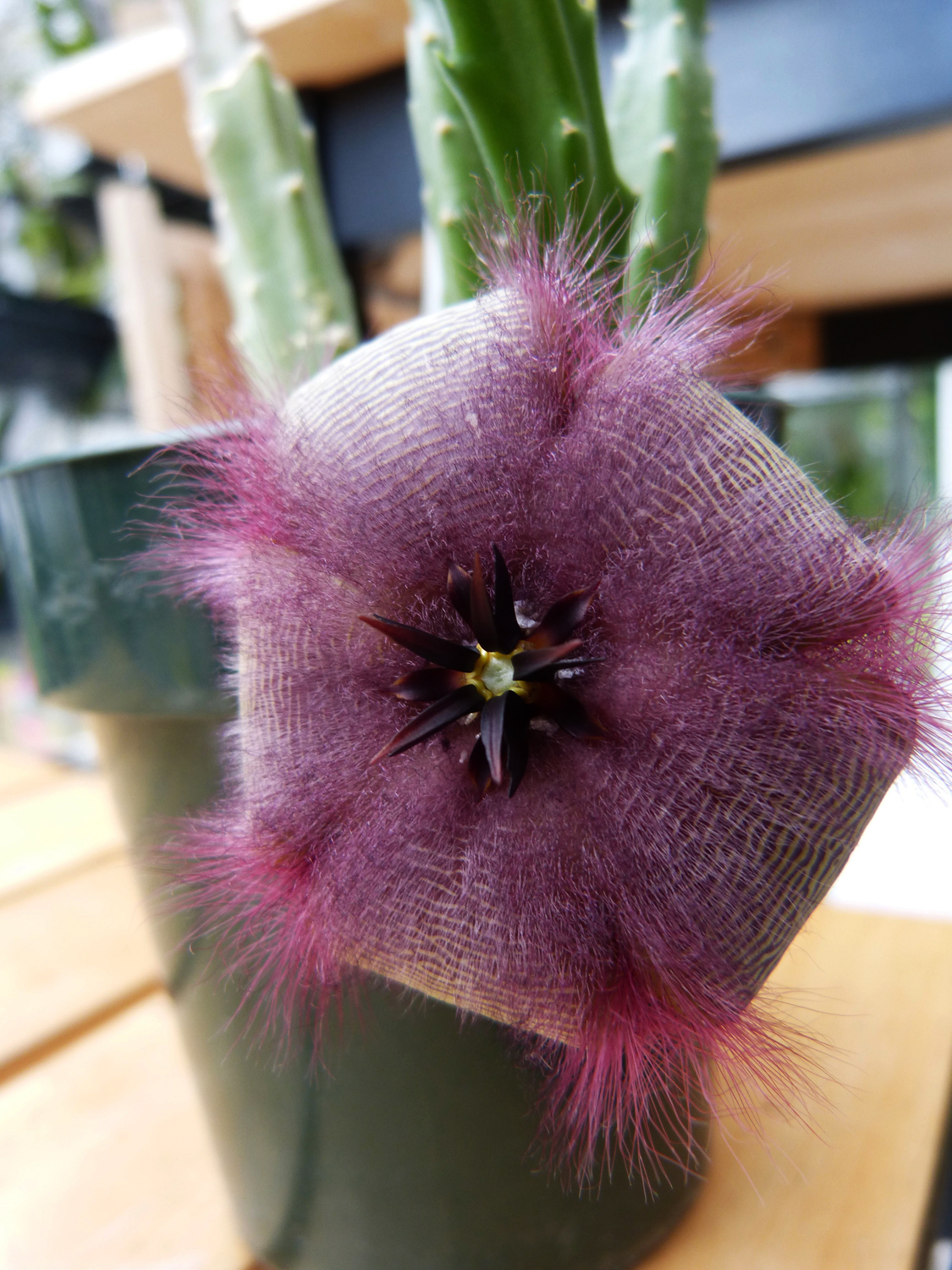
As a counterpoint to the lovely floral perfumes from the orchids, I’ve had a Stapelia hirsuta blooming for the past week or so. A Stapelia is a type of South African succulent plant that looks vaguely like a spineless cactus. When the bud first appeared, I was amazed at its size, and was even more amazed when it started to open, revealing a zebra-striped flower covered with long, maroon-colored hairs. Then the flower started to emit its fragrance. It smells exactly like rotten meat, obviously to attract flies to pollinate it. I think the scent lure was effective because there were some big flies expressing an interest in it. Who knows – maybe it will produce a fruit and seeds to go into my collection of other seed-grown baby cacti and other succulents.

Saturday, February 23, 2013

THE BIG WHITE TROPICAL: AERANGIS DISTINCTA


It’s still cold outside, but the plants and the birds don’t seem to notice. This is the season when my orchids go full steam ahead into growth and spring blooming. One that’s blooming right now is Aerangis distincta, a Central African species. The plant itself is fairly small, and was happily growing in my greenhouse until someone (a walk-in customer, I think) bumped against it and knocked off most of its flower spike. Just one bud was left, but it’s blooming now, wafting out its fragrance as soon as it gets dark.

The flower is creamy-white tinged with orange. I think it must have gone all-out to make up for its missing companions, because it’s huge. The nectar spur is over 8 inches long! Seen in profile, the flower has sort of a streamlined, almost art-deco shape reminiscent of an airplane propeller, or a rocket nose-cone with the nectar spur shooting out after it in a perfect arc. The fragrance is the quintessential tropical white flower scent, like a mix of indolic jasmine, gardenia, ylang-ylang, orange blossom, and tuberose, with mega-sillage. It’s gorgeous. It reminds me of the tropical perfume that I’ve been working on. Over the weeks that the flower blooms, the fragrance changes a little, going from all-out indolic white tropical flowers to white flowers accompanied by lots of spice and aromatic woody notes. I’m always struck by the basic similarity of all night-fragrant white flowers, whether orchids or very different types. 


Another plant that’s blooming right now, in addition to the usual cattleyas and big blue vandas, is Maxillaria juergensii. It’s a tiny orchid species with spiky leaves that produces huge flowers for the size of the plant. The flowers are dark red, with a super-shiny, wet-looking lip. They smell like dead meat. You win some, you lose some. I’m sure the flies like the fragrance, but I don’t think it’s going to end up as a perfume.